
How Ukraine Can Help Donald Trump Defeat Iran
Ukrainian President Volodymyr Zelensky understands that the Iran War is just another front in the war between autocracies and democracies.
Автор - Michael Lucchese
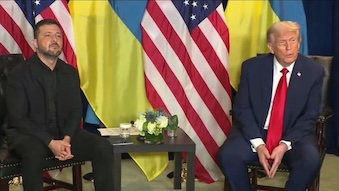
President Donald Trump and his Ukrainian counterpart Volodymyr Zelensky have a strange relationship, to put it delicately. From “perfect” phone calls to clashes in the Oval Office, it may seem that the two men have been destined to be at loggerheads since the American’s first term. It is perhaps surprising, then, that Zelensky has emerged as one of the most vocal supporters of Trump’s waragainst the Islamic Republic of Iran.
Far from freeloading off the United States, Ukraine’s loyalty in the midst of this war is a remarkable testament to the beleaguered nation’s dedication to the West. Zelensky and his countrymen understand that defeating the Iranian regime is about more than the narrow regional politics of the Middle East; it is about upholding the international order. They are willing to share their battle-won expertise and even industrial capacity precisely because they understand the scale of the fight the West faces. The Trump administration would do well to recognize these contributions and use them to help win the war against the radicals in Tehran.
Zelensky first made his unwavering support for Operation Epic Fury clear on February 28, hours after the airstrikes began. “It is important that the United States is acting decisively,” he wrote on X (formerly Twitter). “Whenever there is American resolve, global criminals weaken.” The statement is remarkable not only for its moral clarity about the evil of tyranny, but also for its fundamental realism about geopolitics. Zelensky understands that the global war against autocracy cannot be divided into artificial spheres of influence; what happens in one theater affects all the others.
The Ukrainian president echoed earlier statements from his government supporting strong action against the Iranian regime. Last summer, Ukrainian officials stood firmly by the United States and Israel during strikes to contain the Islamic Republic’s nuclear threat. The Ukrainians’ support of American action against Iranian terrorists is not rooted in partisan politics, but rather the knowledge that, as one statement from Ukraine’s Ministry of Foreign Affairs put it, “Iran is complicit in the crime of aggression against Ukraine.” To them, the conflict with the regime is not a “Democrat war” or “Republican war,” but simply a stand against a rogue state that has aimed its drones and missiles directly at the heart of the international order.
The Islamic Republic has formed a new axis of aggression with President Vladimir Putin’s Russia and Communist China–any blow to the regime in Tehran is a blow to the axis as a whole. Before these strikes decapitated the regime, Tehran had become a kind of “arsenal of autocracy,” providing weapons and energy to powers hostile to an American-led world order. As Zelensky pointed out in his statement, “the Iranian regime chose to become Putin’s accomplice and supplied him with Shahed drones, and not only the drones themselves, but also the technologies to produce them.” Russia has used Iranian drones in more than 57,000 strikes since the invasion began. The Ukrainian president understands Operation Epic Fury will directly disadvantage the Russian war effort.
On the battlefield, Ukraine is taking full advantage of Russia’s distraction in Iran to launch a counterattack. Experts from the Institute for the Study of War have recently found that these efforts may disrupt Putin’s plans for a spring offensive, and that the “cascading effects” of Ukrainian advances show how constrained the Russian force structure in Ukraine really is. The Kremlin needs as much support as it can get from Iran and China to maintain its invasion, and Trump’s decisive action in the Middle East will sap that away. Winning the “forever war” against the Islamic Republic will help put a stop to Putin’s own endless war against Ukraine.
Of course, the Chinese Communist Party will also feel the squeeze as the Iranian regime destabilizes, and putting the CCP on the back foot helps both the United States and Ukraine. China buys over 80 percent of Iran’s foreign oil exports and invests heavily in Iranian infrastructure, telecommunications, and weapons production. The aforementioned Shahed drones include Chinese parts. Most of China’s regional influence in the Middle East runs through Iran, and these decapitation strikes undermine that strategy. Coupled with the loss of Venezuelan oil from the also-decapitated Maduro regime, Chinese President Xi Jinping is facing a potential energy shortage that could hamper his imperialist ambitions. The support he has provided Iran and Russia might just prove his undoing.
Because he is on the frontlines of the fight against the axis of aggression, Zelensky knows just how pivotal Operation Epic Fury will be for the future of his own country and the world. “People cannot know the day or the hour, yet every act of evil, terror, and aggression against neighbors ultimately meets a just response,” he wrote in his initial statement at the beginning of the conflict. “Ukraine is ready to help every nation so that security and justice increase, and terrorist regimes decrease.”
Zelensky’s country, like Israel and Taiwan, is fighting for liberty against the imperialist designs of ideological aggressors. These frontline nations are so eager to work with the United States because they know that we represent the last, best hope for freedom in the world.
Ukraine is offering the Western alliance more than words, too. In a video messageon Sunday, Zelensky committed to sharing his country’s missile defense experience with Western and Middle Eastern allies and to “developing Europe’s shared defensive capabilities.” “Europe must have enough air defense missiles, enough experience in shooting down drones,” he said, “and sufficient production of modern interceptor drones.”
Unlike too many Western European leaders, Zelensky is willing to invest in national security rather than just rely on the United States. American support is no doubt vital to Ukraine’s survival. Still, Zelensky is seeking to show the ways that it is an investment that will pay dividends for us beyond just one region.
More than 200 Ukrainian experts in drone warfare have already deployed to the Middle East to help protect American bases and the Gulf states. Washington apparently requested the assistance last week as Iranian drones rained down on US positions in the region. “We reacted immediately,” Zelensky told The New York Times in an interview, “I said, yes, of course, we will send our experts.” The Pentagon is also looking to purchase cheap, mass-produced drone interceptors from Ukraine—a much cheaper option than Patriot missiles, and which would also keep stockpiles essential for US security in the Indo-Pacific from depleting too quickly.
This is not the first time Ukraine has offered the United States such a report. Recent reporting from Axios suggests that officials from the war-torn country tried making a deal with the Trump administration last August, after its first bombing campaign against Iran, to supply anti-drone technology designed to counter the regime’s Shahed models. At the time, the president expressed some interest, but sources told Axios that his team did not follow through. In hindsight, it would have been wise to partner with the Ukrainians at that early stage—but late is better than never. One hopes that administration officials have learned just how interconnected the threats to American security really are. The Western alliance needs these kinds of technological advantages to confront its adversaries.
Ukraine is also offering its allies access to innovative battlefield data to train artificial intelligence models. No other country has been so exposed to the struggle of modern warfare, and understanding what has happened in the trenches and across the skies there over the last four years will provide the Western alliance with vital strategic insights. This kind of data-sharing, alongside the missile defense, represents a concrete return on investment after years of US support for the Ukrainian war effort. Anyone interested in protecting American servicemembers and interests should celebrate them. Despite the protestation of Ukraine’s critics, the nation really is pulling its weight in the Western alliance.
Unfortunately, not all of America’s friends have been as supportive as Zelensky has been as rockets rain down on our military bases. While some powers, such as the United Kingdom, have reluctantly joined defensive action against Iranian aggression, too many in the European Union have condemned President Trump and dragged their feet. But that only makes Zelensky’s statement all the more impressive; while Ukraine is fighting to join Europe, he is choosing to flout the EU’s elite. He understands that the fundamental realities of geopolitics are far more important than shibboleths about “international law” that amount to nothing more than appeasement.
It is also worth contrasting Zelensky’s support with Russian officials’ utter contempt for President Trump—and their material aid to the Iranian regime. Top Putin ally Dmitry Medvedev, for instance, derided the American president on social media, mockingly calling him “the peacemaker.” The former Russian president claimed that Iran would outlast the United States, despite the fact that Israeli airstrikes have killed many of the regime’s leading figures, including its supreme leader, Ayatollah Ali Khamenei.
To make matters worse, the Kremlin is providing targeting intelligence and advanced weaponry to help the Iranians kill Americans. As The Wall Street Journalrecently reported, Moscow’s satellite imagery reveals the positions of US troops. Russia is also shipping components to build new Shahed drones. Russian leaders know that if the Islamic Republic collapses, they will lose an important weapons depot and regional ally.
Since 2022, Putin’s regime has become a pariah on the global stage—Iran has been one of the few states willing to partner with the Russian leader despite his horrific war crimes. But on an even deeper level, the reason the Kremlin has been so gleefully supportive of Iranian aggression is that it sees the Iranian regime as a proxy for a cold war that Putin has been waging against the West for years.
We must confront the basic truth that the Iranian regime and its Russian and Chinese partners want to harm Americans and our interests. Clearly, President Trump ordered these attacks against the Islamic Republic because he saw that its despots were negotiating in bad faith; the Kremlin’s recent actions and statements show that Russia is approaching its own negotiations with the West with similar ill intentions. As in the Middle East, the best way to defend American interests in Eastern Europe is resolute strength. When we are bold enough to do that, our enemies tremble, and our allies are emboldened.
There is a lesson in this that one hopes the Trump administration learns. For close to two decades now, the late Ayatollah Ali Khamenei and his senior partners, Vladimir Putin and Xi Jinping, have been working against the American-led world order—but now America is back on the offensive. When we lead, the freedom-loving peoples around the world follow. This is not the time to take an “off-ramp,” but rather a moment to work with partners such as Ukraine and Israel for the sake of victory, security, and peace.
Michael Lucchese is the founder of Pipe Creek Consulting, an associate editor ofLaw & Liberty, and a contributing editor to Providence. Previously, he was a Krauthammer Fellow at the Tikvah Fund, a visiting scholar at the Liberty Fund, and an aide to US Senator Ben Sasse. His writing on national security, the conservative movement, and the American founding has been published widely at outlets such as The Wall Street Journal, The Washington Post, National Review, and The Washington Examiner.
Коментар